The Complete Beginner's Guide to Cryptocurrency (2026 Edition)
Everything you need to know about cryptocurrency explained in plain English. Blockchain, wallets, exchanges, DeFi, trading, security, airdrops, and more.


Everything you need to know about crypto as a beginner — from zero to confident — explained like you're having coffee with a friend.
You've heard people talk about Bitcoin. Maybe a friend made money trading crypto. Maybe you saw it on the news. Maybe you're just curious about what all the fuss is about.
Whatever brought you here — welcome. This guide will walk you through absolutely everything you need to know about cryptocurrency as a beginner, from the very basics to the more advanced concepts. No jargon without explanation. No assumptions that you already know anything. Just plain, honest education. We do not dig deep into advanced concepts here. This is to give you a kickstart on your journey. This guide contains affiliate links that are beneficial to you the user and that can generate a small commission to Cryptohub.
Let's start from the beginning.

Chapter 1: What Is Cryptocurrency?
Magic fairy dust or something real?
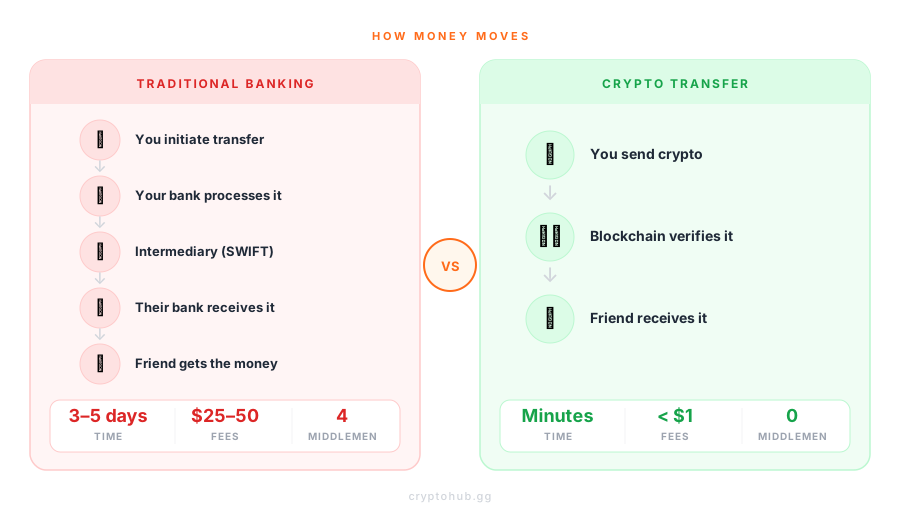
Imagine you want to send money to a friend in another country. You'd normally go through a bank. The bank verifies you, processes the transfer, takes a fee, and your friend gets the money — maybe in 3 to 5 business days.
Cryptocurrency removes the bank from the equation. It's digital money that lives on the internet and allows you to send value directly to another person, anywhere in the world, in minutes. No bank needed. No middleman. No waiting days for a transfer.
The "crypto" part comes from cryptography — the science of secure communication. It's the same technology that protects your online banking and messaging apps. When applied to money, it creates currencies that are extremely difficult to counterfeit or hack.
The first and most famous cryptocurrency is Bitcoin, created in 2009 by a mysterious person (or group) using the name Satoshi Nakamoto. Nobody knows who they are to this day. Since then, thousands of other cryptocurrencies have been created, each with different purposes and features.

Key takeaway: Cryptocurrency is digital money that works without banks, secured by advanced mathematics, and can be sent anywhere in the world almost instantly.
Chapter 2: Why Does Crypto Exist?
The problems crypto was built to solve
To understand why cryptocurrency was invented, it helps to understand the problems with the traditional financial system:
Banks control your money. When you deposit money in a bank, it's technically not fully in your control anymore. Banks can freeze accounts, charge unexpected fees, or even fail (remember the 2008 financial crisis).
Sending money internationally is slow and expensive. Wire transfers can take days and cost significant fees. For migrant workers sending money home, these fees eat into every transfer.
Not everyone has access. About 1.4 billion adults worldwide don't have a bank account. They're effectively locked out of the financial system. All you need to use crypto is a smartphone and internet access.
Privacy concerns. Every transaction you make with a bank card is tracked, logged, and potentially shared. Crypto can offer more financial privacy (though it's not fully anonymous — more on that later).
Inflation and money printing. Governments can print more money whenever they want, which reduces the value of money already in circulation. Bitcoin, for example, has a hard cap of 21 million coins — no more can ever be created, making it more like digital gold than a traditional currency.

Cryptocurrency was designed as an alternative to all of this: a financial system that's open to everyone, controlled by no single entity, and secured by code rather than trust in institutions.
Chapter 3: How Does Blockchain Work?
It's simpler than you think
You'll hear the word "blockchain" a lot. It's the technology that makes crypto possible — and it's actually not as complicated as it sounds.
Think of it like a shared notebook. Imagine a notebook where every financial transaction is written down. But instead of one bank holding this notebook, thousands of computers around the world each have an identical copy. Whenever a new transaction happens, everyone's copy gets updated at the same time.
This is essentially what a blockchain is: a shared, public record of all transactions.
Here's what makes it special:
It's decentralized. There's no single company or government running it. Instead, thousands of computers (called "nodes") spread across the world maintain the network. If one computer goes down, the network keeps running.
It's transparent. Anyone can view the transactions on most blockchains. You can literally look up any Bitcoin transaction that's ever happened.
It's virtually tamper-proof. Once a transaction is added to the blockchain, changing it would require simultaneously altering thousands of copies across the world — which is practically impossible.
How transactions work, step by step:
- You send 1 Bitcoin to a friend.
- That transaction is broadcast to the network.
- Computers on the network verify that you actually have that Bitcoin and haven't already spent it.
- Once verified, the transaction is grouped with other transactions into a "block."
- That block is added to the chain of all previous blocks — the blockchain.
- Your friend receives the Bitcoin. Done.
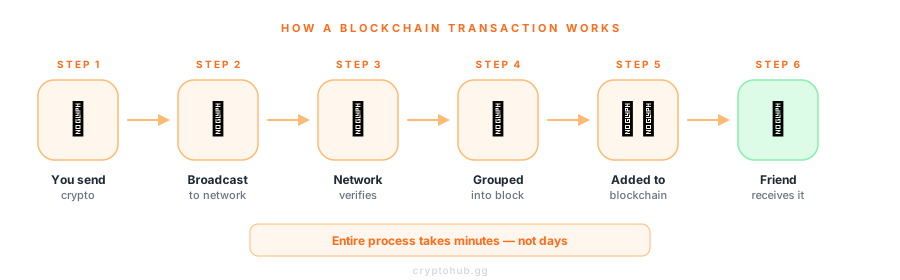
This entire process typically takes minutes, not days. And the fee is usually much less than a bank wire transfer.
Chapter 4: The Different Types of Crypto
Not all coins are created equal
Not all cryptocurrencies are the same. Think of it like the app store — there are thousands of apps, but they serve very different purposes. Here's how to think about the major categories:
Bitcoin (BTC) — Digital Gold
Bitcoin was the first cryptocurrency and remains the largest by far. It's primarily used as a store of value — like digital gold. There will only ever be 21 million Bitcoins, which creates scarcity. Many people buy Bitcoin not to spend it, but to hold it as a long-term investment.
In a major milestone, the first spot Bitcoin ETFs were approved in the US in January 2024, meaning people can now invest in Bitcoin through their regular brokerage accounts and even retirement plans. This was a turning point for mainstream adoption, with major institutions like BlackRock and Fidelity managing Bitcoin funds worth over $100 billion.

Ethereum (ETH) — The World Computer
If Bitcoin is digital gold, Ethereum is a digital operating system. It allows developers to build applications on top of it using "smart contracts" — self-executing programs that run when certain conditions are met. Most of the innovation in crypto (DeFi, NFTs, tokens) is built on Ethereum or on Layer 2 networks that settle back to Ethereum.
Think of Ethereum like the app store platform. Bitcoin is the gold sitting in the vault. Ethereum is the infrastructure where all the shops, games, and financial services are being built.

Solana (SOL) — The Speed Machine
Solana has rapidly become one of the most important blockchains in crypto. Its killer feature? Speed and cost. While Ethereum transactions can take time and cost several dollars in fees, Solana processes thousands of transactions per second at a fraction of a cent each.
This has made Solana the go-to chain for:
- DeFi trading — Jupiter, the leading Solana DEX, has become one of the most used platforms in all of crypto.
- Memecoins and new token launches — the speed and low cost makes Solana the chain of choice for rapid trading.
- NFTs and gaming — fast, cheap transactions make it ideal for in-game economies.
- Everyday payments — the speed makes it practical for real-world transactions.

Solana's ecosystem has exploded in growth, with Phantom as the most popular wallet and an increasing number of developers building on the network. It represents a different approach than Ethereum — sacrificing some decentralization for dramatically better performance. Whether that trade-off is worth it is one of the great ongoing debates in crypto.
Altcoins — Everything Else
"Altcoin" simply means any cryptocurrency that isn't Bitcoin. Beyond Ethereum and Solana, there are thousands, each with different goals:
- XRP (Ripple): Focused on fast international bank transfers.
- Cardano (ADA): An academic, research-driven approach to blockchain development.
- BNB: The native coin of Binance, one of the world's largest exchanges.
- Litecoin (LTC): Often called the silver to Bitcoin's gold. Faster transaction times.
- And thousands more — some valuable, many worthless. This is where research becomes crucial.
Stablecoins — The Bridge Between Crypto and Cash
Stablecoins are cryptocurrencies designed to maintain a stable value, usually pegged 1:1 to the US dollar. They're the most practical coins for everyday use in crypto.
- USDT (Tether): The most widely used stablecoin. When crypto traders say they're "in stables," they usually mean USDT.
- USDC (USD Coin): Similar to USDT but generally considered more transparent about its reserves.
Stablecoins are how most people move money in and out of crypto positions without converting back to traditional currency. They've also become a major payment method globally, with transaction volumes exceeding trillions of dollars annually.
Memecoins — The Wild Cards
You've probably heard of Dogecoin or Shiba Inu. Memecoins are cryptocurrencies that started as jokes or internet memes but sometimes develop real communities and value. They're extremely volatile and risky. Some people have made fortunes on them; many more have lost money. If you engage with memecoins, treat it like a lottery ticket — never invest more than you'd be completely comfortable losing.

Chapter 5: Wallets — Where Your Crypto Lives
Your keys, your crypto, your responsibility
When you own cryptocurrency, you don't actually hold "coins" anywhere. What you own are cryptographic keys that prove you have the right to spend certain coins on the blockchain.
These keys are stored in wallets. There are two main types:
Hot Wallets (Software)
These are apps on your phone or computer that connect to the internet. They're convenient for everyday use but are more vulnerable to hacking since they're always online.
- MetaMask — The most popular wallet for Ethereum and EVM-compatible blockchains. Works as a browser extension.
- Trust Wallet — A popular mobile wallet supporting many different blockchains.
- Phantom — The go-to wallet for the Solana ecosystem. Essential if you plan to use Jupiter or other Solana DeFi platforms.
- Rabby — A newer wallet gaining popularity for its security features and multi-chain support.
Cold Wallets (Hardware)
These are physical devices (they look like USB sticks) that store your keys offline. Since they're not connected to the internet, they're extremely secure. Think of them like a safe for your crypto.
- Ledger — The most well-known hardware wallet brand. Multiple models available at different price points, from the entry-level Nano to the touchscreen Stax.
- Trezor — Another highly respected option with an open-source approach to security.
Our recommendation: If you plan to hold any meaningful amount of crypto, invest in a hardware wallet. A Ledger or Trezor costs less than $100 and could save you from losing thousands. Think of it as insurance.

The golden rule: If you have a significant amount of crypto, keep the majority in a cold wallet. Only keep what you're actively trading or using in a hot wallet.
Your Seed Phrase — The Most Important Thing in Crypto
When you set up a wallet, you'll be given a seed phrase — 12 or 24 random words. This is essentially the master password to your funds. If your phone breaks or your hardware wallet is lost, you can recover everything with this seed phrase.

If someone gets your seed phrase, they get all your crypto. If you lose it and something happens to your wallet, your crypto is gone forever. There is no "forgot password" button in crypto.
Chapter 6: Exchanges — Where You Buy and Trade
Where the buying and selling happens
Cryptocurrency exchanges are platforms where you buy, sell, and trade crypto. Think of them like stock exchanges, but for digital currencies.
There are two main types:
Centralized Exchanges (CEX)
These are companies that operate like traditional brokerages. You create an account, deposit money, and trade on their platform. They hold your crypto for you (in their wallets, not yours).
Pros: Easy to use, high liquidity, customer support, fiat on/off ramps (meaning you can deposit or withdraw traditional currency).
Cons: You don't control your own keys ("not your keys, not your coins"), KYC requirements (you need to verify your identity), and the exchange could be hacked or go bankrupt (remember FTX in 2022).
Popular centralized exchanges include:
- Bitunix — Our top recommendation for global traders. No KYC required for basic trading, 125x leverage available, 180+ trading pairs, and you get a lifetime 20% fee discount signing up through our link. Great liquidity and a clean interface.
- Coinbase — The best option for US-based users. NASDAQ-listed, fully regulated, FDIC-insured USD balances, and very beginner-friendly. Sign up through our link and get a bonus after your first trade.
- For more advanced users/traders, you can consider Coinbase Advanced
- MEXC — Zero maker fees and a massive selection of 3,500+ trading pairs. Great for finding new altcoins early.
- Bybit — One of the largest derivatives exchanges with an excellent interface and copy trading features.
See all our recommended exchanges with detailed comparisons, fee breakdowns, and exclusive sign-up bonuses on our Platforms page.
Decentralized Exchanges (DEX)
These are platforms that operate without a central company. You connect your own wallet and trade directly with other users through smart contracts. No account creation, no identity verification.
Pros: You keep control of your funds, no KYC required, access to newer tokens that aren't listed on centralized exchanges.
Cons: Can be more complex for beginners, no customer support if something goes wrong, vulnerable to smart contract bugs.
Popular decentralized exchanges include:
- Jupiter — The leading DEX on Solana. If you're trading anything on the Solana network, Jupiter is your go-to. It aggregates liquidity from multiple sources to get you the best price.
- Hyperliquid — A high-performance decentralized perpetual futures platform. If you want leverage trading without KYC and with your own wallet, Hyperliquid is the leading option.
- Uniswap — The original DEX, built on Ethereum. Still the most used for Ethereum-based token trading.
KYC: Know Your Customer
Most centralized exchanges require KYC verification — you need to provide ID documents to verify your identity. This is a legal requirement in most countries to prevent money laundering and fraud. Some exchanges like Bitunix allow trading without KYC, though with some limitations. If you're in a restricted region, a VPN like NordVPN may be necessary to access certain platforms. Do your own research on potential risks and legality of doing so in your country. This is not advise, it is publicly available information.
Chapter 7: Understanding Blockchain Layers
Why Layers matter to your wallet
You might hear people talk about "Layer 0," "Layer 1," "Layer 2," or even "Layer 3" — here's what each one means. Think of it like building a city:
Layer 0 — The Foundation
Layer 0 is the infrastructure that allows different blockchains to exist and communicate with each other. If Layer 1 blockchains are individual cities, Layer 0 is the road network connecting them all.
Projects like Polkadot and Cosmos are Layer 0 protocols. They don't process your everyday transactions — instead, they provide the framework for other blockchains to be built on top of them and to talk to each other. This is called interoperability, and it's one of the biggest challenges in crypto: getting different blockchains to work together seamlessly.
As a beginner, you won't interact with Layer 0 directly, but it's the plumbing that makes the multi-chain world possible.
Layer 1 — The Base Blockchain
This is the main blockchain itself. Bitcoin is a Layer 1. Ethereum is a Layer 1. Solana is a Layer 1. These are the foundations where transactions are processed and finalized.
The challenge with Layer 1 blockchains is the "trilemma" — the trade-off between security, decentralization, and speed. It's very difficult to excel at all three simultaneously. Bitcoin chose security and decentralization but is relatively slow. Solana chose speed and security but made some decentralization trade-offs.
Layer 2 — The Scaling Solution
Layer 2 solutions are built on top of Layer 1 blockchains to make them faster and cheaper. Think of Layer 1 as the highway and Layer 2 as express lanes built above it.
For example, Ethereum can be slow and expensive to use directly. But Layer 2 networks like Arbitrum, Optimism, and Base process transactions off the main chain and then settle them back on Ethereum. This makes transactions dramatically faster and cheaper while still inheriting Ethereum's security.
Why this matters to you: When you use crypto, you'll often choose which network to use. Sending USDT on the Ethereum main chain might cost $5-20 in fees (Not right now, but may do again in a bullrun). Sending it on Arbitrum or Solana might cost less than a cent. Always check which network you're using.

Layer 3 — The Apps You Actually Use
Layer 3 is the application layer — these are the decentralized apps (dApps) that you interact with as a user. Think of Layers 0-2 as the invisible infrastructure, and Layer 3 as the apps on your phone.
Examples of Layer 3 dApps:
- Uniswap, Jupiter — Decentralized exchanges where you swap tokens
- Aave, Compound — Lending and borrowing platforms
- OpenSea — NFT marketplace
- Lido — Liquid staking platform
- Hyperliquid — Decentralized perpetual futures trading
When you use Jupiter to swap tokens on Solana, or use Uniswap on Arbitrum, you're using a Layer 3 application running on top of the layers beneath it. You don't need to think about the layers while using them — but understanding the stack helps you make smarter choices about fees, speed, and security.
The Full Stack at a Glance
Layer 0 (Polkadot, Cosmos) → connects blockchains together Layer 1 (Bitcoin, Ethereum, Solana) → the base chain that secures everything Layer 2 (Arbitrum, Optimism, Base) → makes Layer 1 faster and cheaper Layer 3 (Uniswap, Jupiter, Aave) → the apps you actually use
Chapter 8: DeFi — Decentralized Finance
Banking without the bank
DeFi is one of the most revolutionary concepts in crypto. It's the idea of recreating traditional financial services — lending, borrowing, trading, earning interest — but without banks, using smart contracts instead.

How DeFi Works
Instead of a bank deciding who gets a loan, smart contracts handle everything automatically. The rules are written in code, and anyone with an internet connection can participate.
Lending and Borrowing: Platforms like Aave let you deposit crypto and earn interest, or borrow against your holdings. No credit check, no application, no waiting. The smart contract handles everything.
Liquidity Pools: When you trade on a DEX like Jupiter, there's no order book like on a stock exchange. Instead, users deposit tokens into "pools," and trades are made against these pools. In return, liquidity providers earn a share of trading fees.
Yield Farming: This involves moving your crypto between different DeFi protocols to earn the highest possible returns. It can be lucrative but is complex and carries significant risk.
Perpetual Futures (Perps): Platforms like Hyperliquid offer decentralized leveraged trading. You connect your wallet, no account needed, and can go long or short with leverage — all settled on-chain.
DeFi Risks
DeFi is powerful but far from risk-free:
- Smart contract bugs: Code can have vulnerabilities that hackers exploit. Hundreds of millions have been lost to DeFi hacks.
- Impermanent loss: If you provide liquidity, the value of your deposited tokens can change in unfavorable ways.
- Rug pulls: Scam projects where developers drain all the funds and disappear.
- Complexity: It's easy to make mistakes if you don't fully understand what you're doing.
Chapter 9: Airdrops — Free Crypto
Free money — with a catch
Airdrops are when crypto projects distribute free tokens to users, usually as a reward for early adoption or to decentralize their token distribution. Some airdrops have been worth thousands of dollars.

How Airdrops Work
Typically, a new project will reward people who used their platform before the token launched. For example, if you used a new decentralized exchange during its testing phase, they might "airdrop" their new token to your wallet as a thank-you.
How to Position Yourself for Airdrops
- Use new protocols and platforms early (especially those that haven't launched a token yet).
- Bridge tokens between chains (this shows blockchain activity).
- Participate in testnets (test versions of upcoming networks).
- Be active on-chain — make transactions, use DeFi, try new tools.
- Follow crypto communities like Cryptohub where we share airdrop opportunities and guides in our free channels.
Be wary of phishing links. Scammers create fake airdrop pages to steal your funds.
Tax implications. In many countries, airdrops are considered taxable income at the time you receive them.
Not all airdrops are valuable. Many airdropped tokens end up worthless.
Chapter 10: Mining and Staking
Earn crypto by supporting the network
Blockchains need a way to verify transactions and keep the network secure. There are two main methods, and both can earn you crypto:
Mining (Proof of Work)
Mining is how Bitcoin works. Powerful computers compete to solve complex mathematical puzzles. The first to solve it gets to add the next block of transactions and earns a reward (currently 3.125 BTC per block after the 2024 halving).

Staking (Proof of Stake)
Staking is a more accessible alternative used by Ethereum, Solana, Cardano, and many other blockchains. Instead of competing with computing power, you "lock up" your coins to help validate transactions. In return, you earn rewards — similar to earning interest.
How to stake: Many exchanges offer staking with a few clicks. You can also stake directly through your wallet for higher rewards (but with more responsibility).
Risks of staking: Your tokens may be locked for a period, meaning you can't sell them during market crashes. And if the network has issues, stakers can potentially lose a portion of their stake (called "slashing").
Chapter 11: NFTs — Digital Ownership
More than just overpriced JPEGs
NFTs (Non-Fungible Tokens) are unique digital assets that prove ownership of a specific item — like art, music, or collectibles. Unlike Bitcoin where every coin is identical, each NFT is one-of-a-kind.
A simple analogy: Think of the Mona Lisa. Anyone can print a copy, but there's only one original. An NFT is like a digital certificate of authenticity that says "this is the original" — recorded permanently on the blockchain.

What NFTs Are Used For
- Digital art and collectibles — The most well-known use case, and the one that likely makes less sense
- Gaming items — In-game skins, weapons, or characters that you truly own and can sell.
- Membership passes — Some communities use NFTs as access tokens.
- Music and entertainment — Artists releasing work directly to fans.
- Real-world asset certificates — An emerging use for property deeds and other documents.
The Current State of NFTs
The NFT market has cooled significantly from its 2021-2022 hype. Many speculative NFT projects lost most of their value. However, the technology itself is finding more practical applications, particularly in gaming, digital identity, and membership systems. If you're interested in NFTs, focus on utility (what it does for you) rather than speculation (hoping the price goes up).
Chapter 12: Crypto Trading Basics
From HODL to leverage — know the game before you play
If you're interested in actively trading crypto (rather than just buying and holding), here are the fundamentals:
Spot Trading
The simplest form of trading. You buy a cryptocurrency at one price and sell it at another. If you buy 1 ETH at $2,000 and sell it at $2,500, you made $500 profit. This is straightforward buying and selling on an exchange.
Futures / Derivatives Trading
This is where it gets more complex — and more dangerous. Futures trading lets you bet on whether a crypto's price will go up (going "long") or down (going "short"), often with leverage — meaning you can control a larger position than you actually have money for.
For example, with 10x leverage, a $100 position acts like $1,000. If the price moves 10% in your favor, you double your money. But if it moves 10% against you, you lose everything. This is called being liquidated.

Leverage is how most beginners lose money. It amplifies both gains and losses. Professional traders use leverage carefully with strict risk management. Beginners should avoid it entirely or use very low leverage (2-3x maximum) until they deeply understand the risks.
Key Trading Concepts
- Stop Loss: An automatic sell order that triggers if the price drops to a certain level. This is your safety net. Always use one.
- Take Profit: An automatic sell order that triggers when the price reaches your target.
- Isolated Margin: Your risk is limited to the amount you put into that specific trade. If you're liquidated, you only lose what's in that position.
- Cross Margin: Your entire account balance is used as collateral. If a trade goes badly enough, you can lose everything in your account. Beginners should always use Isolated Margin.
- Position Sizing: The amount of your total capital you put into a single trade. A common rule is to never risk more than 1-3% of your total capital on a single trade.
Level up your chart reading: TradingView is the industry-standard charting platform used by almost every crypto trader. It's where you'll analyze price action, draw trend lines, and study indicators. The free tier is powerful enough for beginners, and they offer a 30-day free trial of their premium features.
Strategies You'll Hear About
- HODLing: Buy and hold for the long term. The word comes from a famous typo of "HOLD" that became a crypto meme. Many people who simply bought Bitcoin and held it over the years have seen substantial returns.
- Swing Trading: Holding positions for days to weeks, trying to catch medium-term price movements.
- Day Trading: Opening and closing positions within the same day. Requires significant time, knowledge, and emotional discipline.
- Scalping: Making many small, quick trades for tiny profits. Very fast-paced and not recommended for beginners.
- Dollar-Cost Averaging (DCA): Investing a fixed amount on a regular schedule (e.g., $100 every week) regardless of price. This removes the stress of trying to time the market and is one of the most recommended strategies for beginners.

Looking for trading signals with suggested entry and exit points on each trade? Cryptohub Premium provides 100-200 trade setups monthly from 15+ experienced daytraders with clear entry zones, take profits, and stop losses. Learn more
Chapter 13: Security — Protecting Yourself
The internet is trying to steal your crypto
Crypto puts you in full control of your money — which means you're also in full control of your security. There's no bank to call if something goes wrong.
The Biggest Threats
Scams and impersonators. This is by far the number one way people lose money in crypto. Scammers pose as admins, support agents, influencers, and friends. They send DMs offering help, fake investment opportunities, or too-good-to-be-true returns.

The golden rules:
- Turn off DMs from strangers on Discord, Telegram, and Twitter. Every single unsolicited DM about crypto is a scam. No exceptions.
- Nobody legitimate will ever DM you first asking for money or your seed phrase.
- If it sounds too good to be true, it is. Nobody can guarantee you returns.
- Double-check every URL before connecting your wallet or entering credentials. Scammers create perfect copies of real websites with slightly different URLs.
Phishing. Fake websites, emails, and messages designed to steal your login credentials or seed phrase. Always verify URLs manually.
Exchange hacks. While rare for major exchanges, it does happen. Don't keep all your funds on an exchange. Move long-term holdings to a hardware wallet like a Ledger or Trezor.
Security Checklist
- Enable 2FA (Two-Factor Authentication) on every exchange and email account. Use an authenticator app (Google Authenticator, Authy), not SMS.
- Use unique, strong passwords for each platform. Use a password manager.
- Back up your seed phrase on paper, stored in a secure physical location. Never screenshot it, never store it in a notes app, never email it.
- Keep your software updated — wallet apps, phone OS, browser.
- Use a VPN when accessing exchanges, especially from restricted regions or public Wi-Fi. NordVPN is our recommendation — top-rated for speed and security.
- Be skeptical of everything. Verify first, click later.
Chapter 14: The Crypto Market Cycle
Why history keeps repeating — and how to use it
Crypto markets tend to follow cyclical patterns, often influenced by Bitcoin's halving — an event that occurs approximately every four years, cutting the rate at which new Bitcoin is created in half.
The Typical Cycle
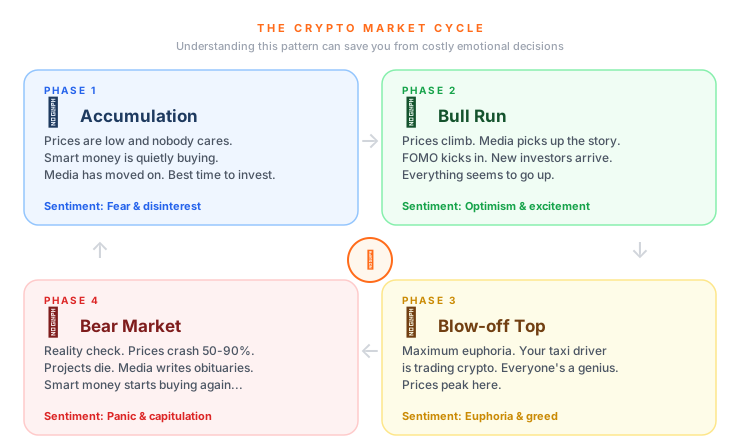
Accumulation: Prices are low, interest is quiet, and smart money is buying. This is often after a major crash.
Bull Run: Prices start rising. Media attention grows. New investors pour in. Everything seems to go up. Euphoria takes over.
Blow-off Top: Prices reach unsustainable levels. Everyone is talking about crypto. People who've never invested before are buying. This is usually when prices are near their peak.
Bear Market / Crash: Reality sets in. Prices drop 50-90% from their peaks. Projects fail. Media writes obituaries for crypto. Most casual investors leave.
Then it repeats.

Understanding this cycle is important because emotional decisions based on hype (buying at the top) or fear (selling at the bottom) are the primary way people lose money. The most successful crypto investors tend to be those who buy during quiet periods and take profits during euphoria.
Chapter 15: Real-World Assets (RWAs) and Tokenization
When blockchain meets the real world
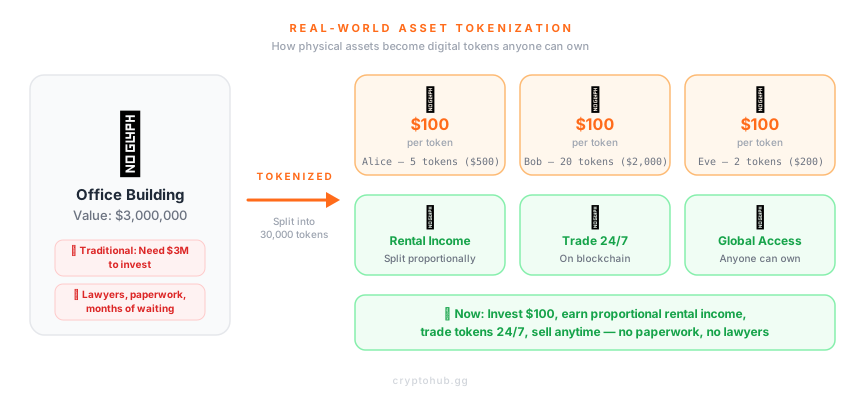
One of the biggest emerging trends in crypto is the tokenization of real-world assets. This means taking traditional assets — stocks, bonds, real estate, commodities — and representing them as tokens on a blockchain.
Why does this matter? It makes these assets more accessible, tradeable 24/7, and divisible into smaller fractions. Instead of needing $300,000 to buy a rental property, you could own a $100 token representing a fraction of that property and earn proportional rental income.
Tokenized US government bonds alone exceeded $30 billion in 2025, and major institutions like BlackRock are actively building in this space. This is one of the areas most likely to drive mainstream adoption in the coming years.
Chapter 16: Stablecoins and the Digital Dollar
The most boring — and most useful — crypto
Stablecoins deserve a deeper look because they've become one of the most important parts of the crypto ecosystem. Their annual transaction volume now exceeds trillions of dollars.
Why Stablecoins Matter
- Safe haven during volatility. When crypto prices are crashing, traders move into stablecoins to preserve value without leaving the crypto ecosystem.
- International payments. Sending USDT to someone in another country is nearly instant and costs cents, compared to days and hefty fees with traditional wire transfers.
- Unbanked populations. In countries with unstable currencies or limited banking access, stablecoins provide a way to save and transact in dollars.
- DeFi building block. Most DeFi protocols use stablecoins as their base currency for lending, borrowing, and earning yield.
Regulation Is Coming
The US passed the GENIUS Act in 2025, establishing clear rules for stablecoin issuers — they must maintain full reserves, submit to audits, and meet compliance standards. This is actually positive for the space, as it adds legitimacy and consumer protection. Other countries are following with similar frameworks.
Chapter 17: Crypto and AI
The buzzword collision of the decade
Artificial intelligence and blockchain are converging in interesting ways:
- AI tokens represent projects building AI infrastructure on blockchain, allowing decentralized computing power and data sharing.
- AI-powered trading tools use machine learning to analyze market patterns, though they're far from foolproof.
- Decentralized AI projects aim to prevent any single company from controlling AI technology.
This intersection is growing rapidly and is worth watching, but be cautious — many projects use "AI" as a marketing buzzword without meaningful technology behind it.

Chapter 18: Crypto ETFs — The Bridge to Traditional Finance
Wall Street finally joined the party
In January 2024, the SEC approved the first spot Bitcoin ETFs in the US. This was a watershed moment that allowed regular investors to gain Bitcoin exposure through their normal brokerage accounts — no crypto wallet or exchange needed.
By late 2025, spot Bitcoin ETFs held over $100 billion in assets, and spot Ethereum ETFs followed with billions more. Major banks including Morgan Stanley filed to launch their own Bitcoin ETFs. Trump's administration signed multiple executive orders supporting digital assets, including establishing a Strategic Bitcoin Reserve.
What this means for you: If you want crypto exposure but aren't comfortable with wallets and exchanges, you can simply buy a Bitcoin ETF through the same platform where you buy stocks. For US-based users, Coinbase also offers a simple, regulated way to get started.
However, owning a Bitcoin ETF is not the same as owning Bitcoin. You don't hold the keys, you can't use it in DeFi, and you're trusting the fund manager. For true crypto participation, you'll eventually want to learn how wallets and exchanges work.
Chapter 19: Taxes and Legal Considerations
The chapter nobody wants to read but everybody needs
This isn't the exciting chapter, but it's important.

The Basic Tax Reality
In most countries, cryptocurrency is treated as property for tax purposes. This means:
- Selling crypto for profit triggers capital gains tax.
- Trading one crypto for another (e.g., Bitcoin to Ethereum) is also a taxable event.
- Receiving crypto as payment or through airdrops is often treated as income.
- Simply holding crypto is generally not taxable until you sell or trade it.
Keeping Records
Track every transaction from day one. This is where most people create headaches for themselves — they trade for a year, then realize they have no idea how to calculate their gains and losses across dozens of exchanges and wallets.
Make it easy on yourself: Koinly is a crypto tax tool that connects to your exchanges and wallets, automatically tracks all your transactions, and generates tax reports ready for your accountant. It supports most countries' tax rules and saves hours of manual work. Set it up early — your future self will thank you.
The Legal Landscape
Crypto regulation varies dramatically by country. Some nations have embraced it fully, others have banned it outright. In 2025, the US made significant progress with multiple pieces of legislation providing clearer rules for the industry. Europe's MiCA regulation also established comprehensive rules for crypto businesses.
Before getting involved in crypto, understand the rules in your specific country. Ignorance isn't a defense if tax authorities come knocking.
Chapter 20: Common Beginner Mistakes
Learn from everyone else's expensive lessons
Almost every beginner makes at least one of these mistakes. Knowing them in advance could save you a lot of money and stress:

- Investing more than you can afford to lose. Crypto is volatile. Never invest rent money, emergency funds, or money you need in the short term.
- Chasing pumps. When you see a coin has gone up 500%, the move is likely almost over. Buying in at the top is the fastest way to lose money.
- Not using a stop loss. Every leveraged trade should have a stop loss. No exceptions.
- Using cross margin as a beginner. Use isolated margin. Always. One bad trade on cross margin can wipe your entire account.
- Trusting strangers online. Whether it's Twitter, Telegram, Discord, or YouTube — be skeptical of everyone promoting a specific coin. Ask yourself: what's in it for them?
- Sending crypto to the wrong network. If you send Ethereum on the wrong network, it can be lost forever. Always double-check the network before confirming a transaction.
- Not securing your seed phrase. This has been said multiple times in this guide because it's that important.
- Trading with emotions. Fear and greed are your worst enemies. Have a plan before you enter a trade and stick to it.
- Ignoring risk management. No single trade should be able to ruin you. Risk 1-3% of your capital per trade, max.
- Ignoring taxes. Just because crypto feels anonymous doesn't mean it is. Blockchain transactions are public and traceable. Set up Koinly from day one and save yourself the panic.
Chapter 21: Getting Started — Your First Steps
Your first steps into crypto — right now
Ready to take the plunge? Here's a practical step-by-step:
Step 1: Educate yourself. You're already doing this. Keep going. Read, watch, learn — but be selective about your sources.
Step 2: Join a community. Crypto is better with people around you. Join communities where you can ask questions and learn from experienced cryptodegens and crypto traders. This is exactly what Cryptohub is built for — a free community of 55,000+ crypto enthusiasts with educational content, market updates, airdrop guides, and more.
Join Cryptohub on Discord — it's free, and you'll be in good company.
Step 3: Set up an exchange account. Choose a reputable exchange and deposit a small amount you're comfortable learning with. Start small. Bitunix is great for global users who want low fees and no KYC hassle. Coinbase is ideal if you're US-based and want a regulated, beginner-friendly option.
Step 4: Buy your first crypto. Start with Bitcoin, Ethereum or Solana — they're the most established and least risky (relatively speaking). Don't jump straight into obscure altcoins.
Step 5: Get a hardware wallet. (If you carry significant funds (to you)) Once you've bought crypto worth protecting, invest in a Ledger or Trezor. Transfer your holdings off the exchange. Most beginners with non significant funds can skip this step.
Step 6: Set up TradingView. Primarily if you intend to trade, but can be useful even if you're just holding, learning to read a basic price chart is empowering. Start with the free tier.
Step 7: Set up Koinly. Connect your exchange accounts from day one. Tax tracking is infinitely easier when done in real time rather than retroactively. You submit your wallet addresses to the software, but there is no wallet connecting involved so your funds stay safe.
Step 8: Explore and learn. Once you're comfortable with the basics, start exploring: try a decentralized exchange like Jupiter, look into staking, follow market news, learn basic chart reading. Use a VPN if you need to access platforms from restricted regions. There are risks involved in doing so, so make sure you are fully aware of that before you attempt such a bypass.
Step 9: Consider premium education. When you're ready to take trading seriously, structured learning from experienced traders can dramatically accelerate your progress and help you avoid costly mistakes. Cryptohub's premium membership gives you access to 100-200 trading signals per month from 15+ experienced traders, live coaching sessions, and a comprehensive onboarding course. This is not a place where you get spoon-fed knowledge. YOU have to put in the work. This is the key factor to learning anything. Dig deep and find your motivation to start learning.
Get Cryptohub Premium Trading access
Glossary of Common Crypto Terms
| Term | Meaning |
|---|---|
| HODL | Hold on for dear life — buying and holding long-term |
| DYOR | Do your own research |
| FUD | Fear, uncertainty, and doubt — negative sentiment |
| FOMO | Fear of missing out |
| Whale | Someone who holds a very large amount of crypto |
| Gas | The fee you pay to make a transaction on a blockchain |
| Liquidity | How easily an asset can be bought or sold without affecting the price |
| Market Cap | Total value of all coins in circulation (price times supply) |
| ATH | All-time high — the highest price an asset has ever reached |
| DCA | Dollar-cost averaging — investing fixed amounts at regular intervals |
| Degen | Short for degenerate — a risk-loving crypto trader (used affectionately) |
| Rug Pull | A scam where developers abandon a project and take investors' funds |
| Tokenomics | The economics of a token — supply, distribution, inflation, utility |
| TVL | Total value locked — the amount of money deposited in a DeFi protocol |
| On-chain | Activity that happens directly on the blockchain |
| Off-chain | Activity that happens outside the blockchain |
| CEX | Centralized exchange |
| DEX | Decentralized exchange |
| Seed Phrase | The 12-24 word recovery code for your wallet |
| Private Key | The secret key that gives access to your crypto |
| Public Key | Your wallet address — like an email address for receiving crypto |
| Slippage | The difference between expected and actual price of a trade |
| APY | Annual Percentage Yield — the yearly return on staking or lending |
| Impermanent Loss | Potential loss from providing liquidity to a DEX pool |
| Bridge | A tool for moving crypto between different blockchains |
| Mainnet | The live, production version of a blockchain |
| Testnet | A test version of a blockchain for developers and users to experiment |
| RWA | Real-world asset — traditional assets tokenized on blockchain |
| ETF | Exchange-traded fund — a traditional investment product now available for crypto |
| Perps | Perpetual futures — leveraged trading contracts with no expiry date |
| NFA | Not financial advice — a disclaimer used when sharing opinions |
| KYC | Know Your Customer — identity verification required by most exchanges |
Final Thoughts
Crypto is one of the most exciting developments in modern finance and technology. It's also one of the riskiest spaces for uninformed participants. The difference between the two comes down to education.
You don't need to understand everything overnight. The fact that you've read this far already puts you ahead of most people entering the space. Take it one step at a time. Start small. Ask questions. Be skeptical of easy promises. Protect your security above all else.
And remember — in crypto, the most important investment you can make is in your own education.

This guide was created by Cryptohub — a free Discord community of 55,000+ crypto traders and enthusiasts. Whether you're a complete beginner or an experienced trader looking for signals and community, there's a place for you.
Disclaimer: This guide is for informational and educational purposes only. Nothing in this guide constitutes financial advice. Cryptocurrency markets are highly volatile, and you should never invest more than you can afford to lose. Always do your own research before making any investment decisions. Some links in this guide are affiliate links — using them supports Cryptohub at no extra cost to you, and often gives you exclusive bonuses or discounts.