
Best Crypto Exchanges in 2026: Top Platforms Compared
Compare the best crypto exchanges in 2026. MEXC, Bybit, Bitunix, Coinbase and Hyperliquid ranked by fees, features, KYC and who each platform is best for.


Last updated: May 2026 | NFA — No financial advise. Always do your own research before depositing funds on any platform.
Affiliate disclosure: This guide contains affiliate links. If you sign up to an exchange through one of our links, Cryptohub may earn a commission at no extra cost to you (You get discounts and/or deposit bonuses). This never influences our rankings or recommendations. Every platform here is one we use or have used recently.
Quick Comparison: Best Crypto Exchanges 2026
| Exchange | Best for | Futures Fees | KYC | Markets |
|---|---|---|---|---|
| MEXC → CEX · Global |
Lowest fees, altcoins 2,000+ trading pairs |
0% / 0.02% Spot 0% / 0.05% |
✅ Not required Optional, raises limits |
Spot + Futures Early listings |
| Bybit → CEX · Global |
All-round trading Derivatives focus |
0.02% / 0.055% Spot 0.10% / 0.10% |
Required Mandatory to trade |
Spot + Futures Options too |
| Bitunix → CEX · Global |
Futures + leverage Up to 200x leverage |
0.02% / 0.06% Spot 0.08% / 0.10% |
✅ Not required Optional, raises limits |
Spot + Futures Perps focus |
| Hyperliquid ⛓️ → DEX · On-chain |
Self-custody, no KYC On-chain perps |
0.015% / 0.045% Spot 0.04% / 0.07% |
✅ None ever Wallet only, fully on-chain |
Spot + Futures Perps-dominant |
| Coinbase → CEX · Regulated |
Beginners, simple buys Regulated on-ramp |
N/A Simple buy / sell · up to 2.5% |
Required Mandatory to trade |
Spot only Simple interface |
| Coinbase Advanced → CEX · Regulated |
Active traders Same account, full order book |
0.40% / 0.60% Base tier · volume-tiered |
Required Mandatory to trade |
Spot + Futures Full order book |
The takeaway from the table: MEXC is the cheapest exchange across both spot and futures by a clear margin. At 0% maker and 0.02% taker on futures, it is roughly half the cost of Bybit and Bitunix per trade. For active futures traders, that compounds into hundreds of dollars per month in saved fees at moderate volume.
Some users from restricted countries suggest using a VPN for access and trade unverified. It is a very common method, but may come with risks and should be thoroughly reviewed by the reader before attempting. Regardless, a VPN is a great tool if you wish to increase your privacy. For this you can consider our partner NordVPN.

Wrong exchange = higher fees, bad fills, and potential loss of funds. It matters more than most people think.
This guide covers the top CEX and DEX platforms in 2026 — who each one is for, what it actually costs, and whether it can be accessed globally without completing the KYC (Know your customer). Every fee figure below was verified against each exchange's published fee schedule in May 2026.
This guide covers both centralised exchanges (CEX) and one decentralised exchange (DEX) — Hyperliquid — for traders who want to trade fully on-chain without handing custody of their funds to a company. The short version of the difference: CEXs hold your funds on your behalf (like a bank), while a DEX lets you trade directly from your own wallet with no middleman and no KYC.
HyperLiquid, and on chain trading in general, is for more advanced crypto users. Start with a CEX, learn, then consider moving on chain at a later stage.
MEXC - Lowest fees & Best Altcoin selection
TL;DR — The cheapest exchange in this guide on both spot and futures. 0% maker fees across the board and only 0.02% taker on futures — roughly half the cost of competing exchanges. Pair that with 2,000+ trading pairs and early listings, and MEXC is hard to beat for active traders.
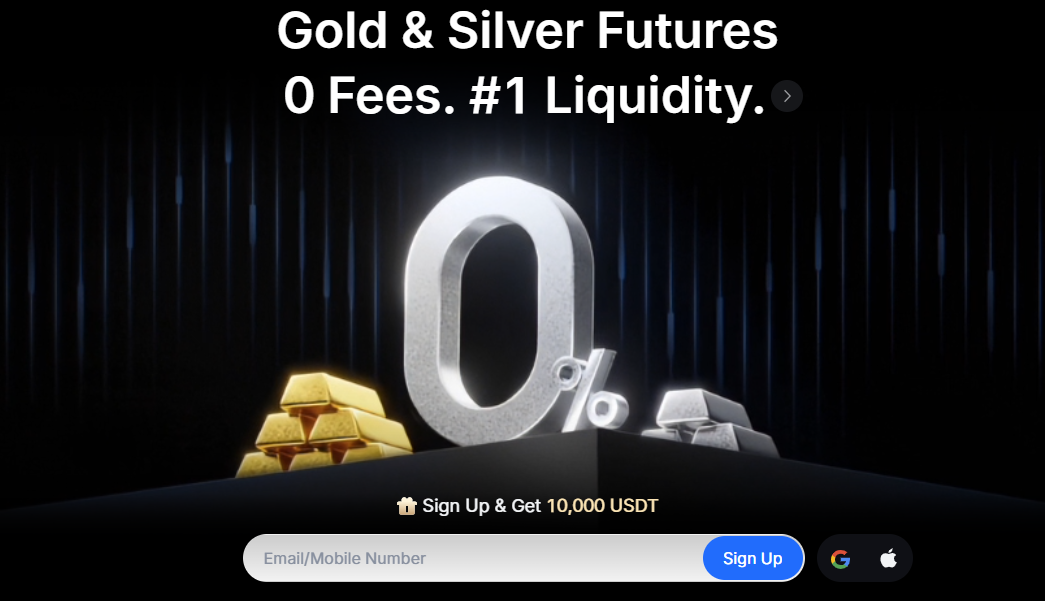
MEXC sits at the cheapest end of the fee table in this guide on every market type. Most exchanges charge 0.02%–0.06% taker on futures. MEXC charges 0.02% — and zero on the maker side. On spot, the gap is even wider: zero maker fees as a permanent standard, not a promotion, plus the largest altcoin selection of any exchange in this guide.
Best for: Active futures traders who want the cheapest fees available, altcoin hunters, and anyone trading early-stage tokens.
Key features:
- 2,000+ trading pairs — widest selection in this guide
- Lowest base-tier fees on both spot and futures
- Among the first exchanges to list new projects
- Futures up to 200x leverage
- Periodic zero-fee promotions on major pairs (BTC, ETH, XRP, etc.)
- MX token holdings unlock additional 50% fee discount
- 100% proof of reserves published
Fees:
- Futures: 0% maker / 0.02% taker (base tier, no token holdings required)
- Spot: 0% maker / 0.05% taker (base tier)
- Holding 500+ MX tokens unlocks an additional 50% discount across both
- Frequent zero-fee promotions on 100+ major pairs
Pros: Cheapest fees in this guide · Largest altcoin selection · Zero maker fees as standard · Strong API and bot support
Cons: Mandatory KYC not required for basic use but some regions are geo-blocked without a VPN · Lower liquidity on smaller-cap pairs · Some listed projects are very low quality — always DYOR
Want a daily edge in your trading? Or simply learn how to trade on your own?
Thousands of traders use Cryptohub for live trade setups, analyst access, and structured courses — built around these exact platforms.

BITUNIX - High leverage, no KYC.
TL;DR — Futures-first exchange with leverage up to 200x. Fees are competitive but slightly higher than Bybit and MEXC at base tier. Strong appeal if you need the maximum leverage on offer or want a leaner, more focused trading terminal.
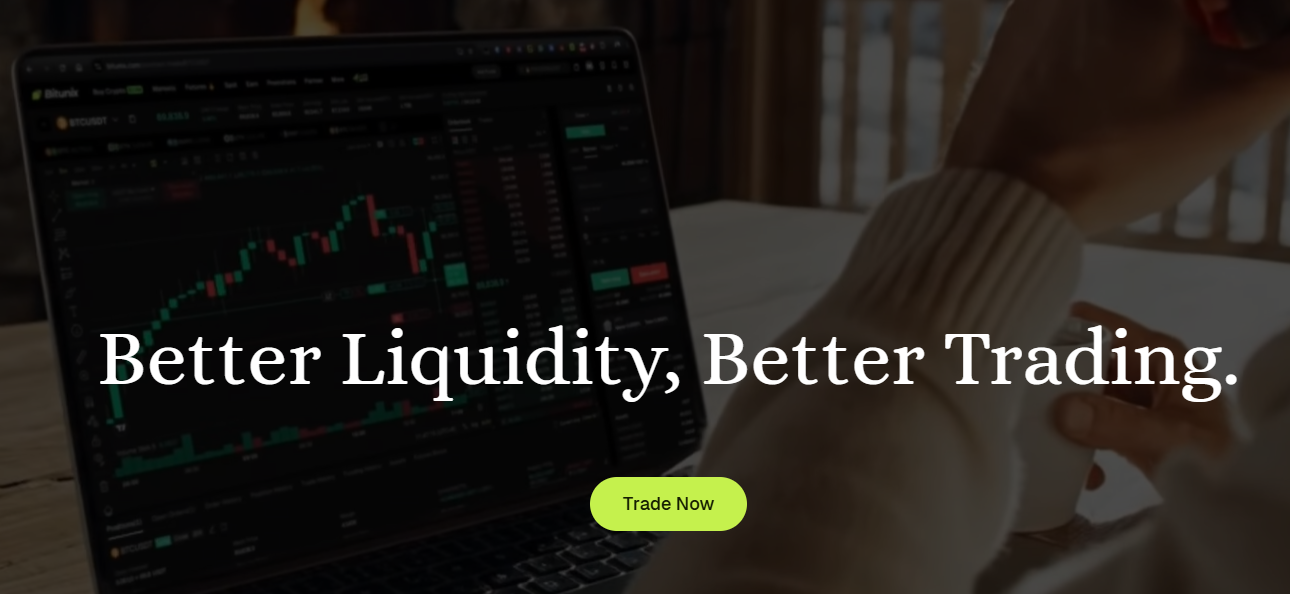
Best for: Active futures traders who want up to 200x leverage or prefer a derivatives-focused exchange without the spot-and-everything-else overhead.
Key features:
- USDT-M, USDC-M and Coin-M perpetual futures
- Up to 200x leverage on select contracts
- Low-latency matching engine
- Hedge mode for simultaneous long/short positions
- Grid trading and copy trading
- API access for algorithmic strategies
- Proof of reserves published
- Optional KYC (withdraw up to 500k USDT/day without verification)
Fees:
- Futures: 0.02% maker / 0.06% taker (VIP 0 base tier)
- Spot: 0.08% maker / 0.10% taker (VIP 0 base tier)
- VIP 7 (highest tier) drops futures to 0.006% maker / 0.03% taker
- Referral discounts can provide a permanent 20% reduction
Pros: Up to 200x leverage · Optional KYC · Hedge mode · Fast execution · Proof of reserves
Cons: Some regions geo-blocked without a VPN · Slightly higher base-tier fees than MEXC or Bybit · Spot market smaller than MEXC

BYBIT - Great All-Round Exchange for Active Traders
TL;DR — The most widely used KYC platform inside Cryptohub. Best balance of features, liquidity, and tooling for active traders. Fees are not the absolute lowest but the platform depth and execution quality justify it for most. Note that Bybit requires KYC to trade.
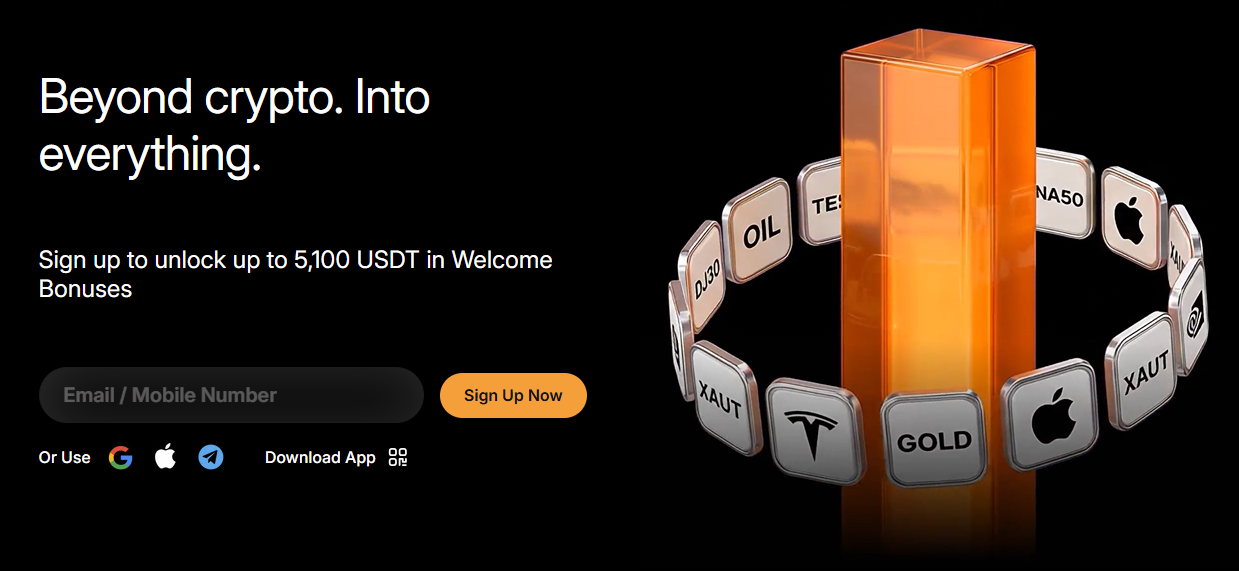
Top-five globally by derivatives volume. Spot, futures, options, and copy trading all in one place. Clean enough for intermediate traders, deep enough for professionals. The platform's matching engine and liquidity are among the best in the industry.
Best for: Traders at any level above complete beginner who want the strongest all-round platform and don't mind completing KYC.
Key features:
- Spot, perpetual futures, inverse futures, options
- Copy trading — follow verified top performers automatically
- Up to 100x leverage on major pairs
- Bybit Earn for passive yield on idle assets
- 24/7 live customer support
- Proof of reserves published
- Strong API for algorithmic strategies
Fees:
- Futures: 0.02% maker / 0.055% taker (base tier)
- Spot: 0.10% maker / 0.10% taker (base tier)
- Options: 0.02% maker / 0.03% taker
- VIP tiers reduce fees based on 30-day volume
- Some referral codes provide a permanent 20% discount on taker fees
Pros: Best-in-class derivatives platform · Excellent liquidity · Strong tooling and API · Regular trading competitions
Cons: Mandatory KYC to trade · Higher fees than MEXC at base tier · Some regions geo-blocked without a VPN
HYPERLIQUID - Best Decentralised Exchange
TL;DR — Trade perpetual futures on-chain, from your own wallet, with no KYC and zero gas fees. The dominant DEX in crypto right now, with fees competitive with the cheapest CEXs.
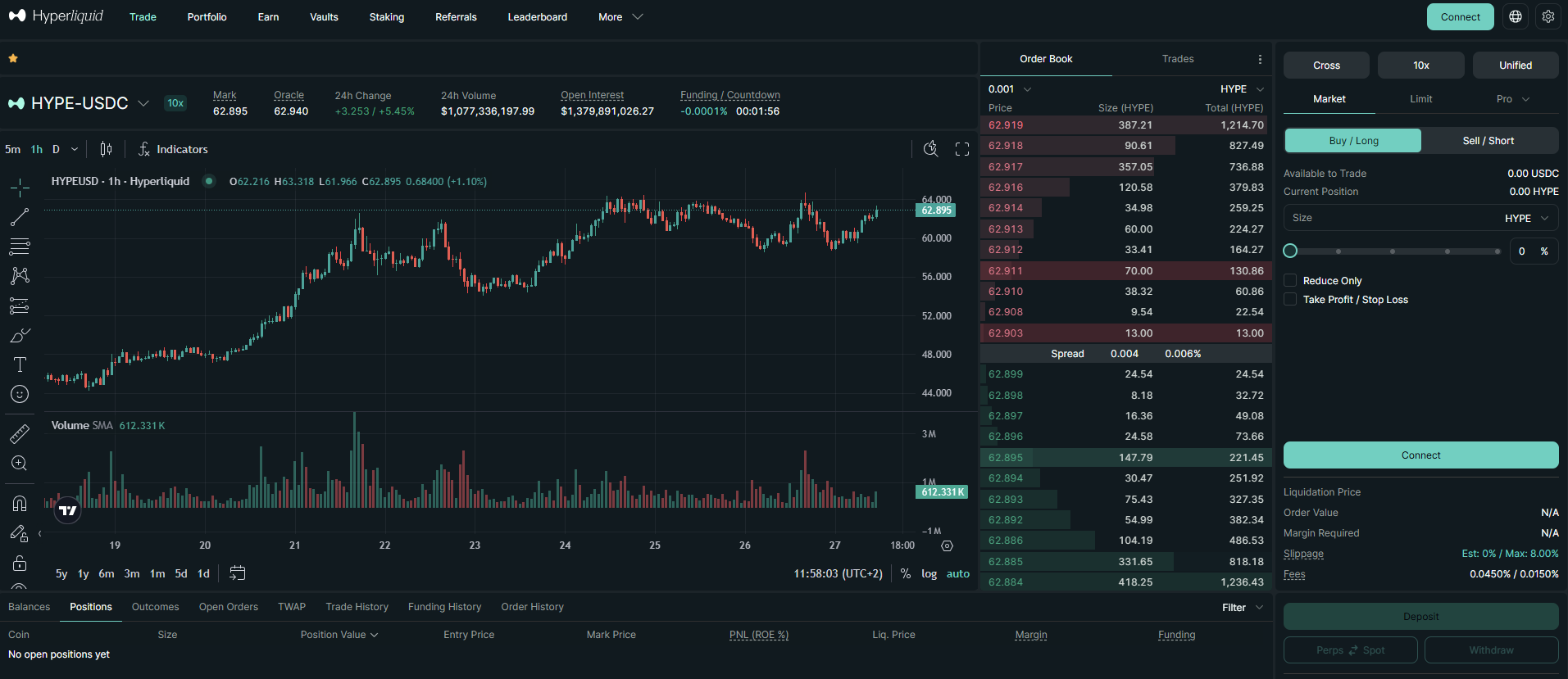
Hyperliquid is different from everything else in this guide. No KYC, no identity, No account to lock or suspend. Connect a wallet and trade. *You still have to deposit funds to the platform to trade.
It commands a majority of all open interest in decentralized perpetuals and has built genuine institutional-grade infrastructure on a custom Layer 1 blockchain. The platform delivers tight spreads, sub-second execution, and a real order book rather than an AMM. Fees on Hyperliquid sit between MEXC and Bybit on futures, making it the cheapest non-CEX option.
Best for: DeFi-native traders, anyone who prefers to skip KYC entirely, and traders who want a self-custodial perps venue.
Key features:
- Fully on-chain perps and spot across 170+ markets
- No KYC — connect MetaMask, PhantomEVM, Rabby, or similar
- Zero gas fees on all trades
- Up to 40x leverage on major pairs
- Real order book with sub-second execution — not an AMM
- Vaults — deposit into HLP for passive yield or run your own strategy vault
- Portfolio margin across all positions
- HYPE staking provides up to 40% fee discount
- 99% of protocol fees buy and burn HYPE
Fees:
- Perps: 0.015% maker / 0.045% taker (base tier)
- Spot: 0.04% maker / 0.07% taker (base tier)
- Fees decrease at higher 14-day volume tiers
- HYPE staking provides up to 40% off
- Zero gas on trades · $1 flat USDC withdrawal fee to Arbitrum
Pros: True self-custody · No KYC · Tight on-chain execution · Everything verifiable on-chain · Genuine deflationary tokenomics
Cons: USDC deposit only — no fiat on-ramp · No mobile app · Requires more technical confidence than a CEX · Withdrawals limited to Arbitrum USDC
No sign-up required, just connect your wallet.
Coinbase — Best for US Beginners
TL;DR — Safest beginner and US starting point. Regulated in all 50 states. Fees on the simple buy/sell flow are high so switch to Advanced as soon as you are ready to trade actively.

Best for: US traders buying crypto for the first time. Anyone who needs a fully regulated, government-compliant on-ramp. Available for global users. Preferred for beginners.
Key features:
- Licensed across all 50 US states
- FDIC-insured USD balances up to $250k
- Bank transfer, card, and PayPal funding
- Coinbase Wallet for self-custody
- Staking on supported assets
Fees: Card purchases up to ~2.5%, plus a spread on the displayed price. Bank-transfer purchases incur a flat fee that varies by transaction size. The simple buy/sell flow is genuinely expensive for active trading — switch to Coinbase Advanced (below) for proper order-book pricing.
Pros: Most trusted US exchange · FDIC-insured · Dead simple to use
Cons: Among the highest fees of any major exchange · Fewer altcoins than offshore platforms · Slow customer support
Coinbase Advanced — Best for US Active Traders
TL;DR — Same account as Coinbase, completely different fee structure. If you are trading actively from the US, switch to Advanced right now. Even so, fees remain significantly higher than offshore exchanges like MEXC and Bybit.
Not a separate exchange — it is the professional interface sitting inside your existing Coinbase account. Same login, same funds, dramatically better fees once you cross volume thresholds.
Best for: US traders who want a proper order book, lower fees than simple Coinbase, and futures access.
Key features:
- Full limit, market, and stop order book
- Spot and futures trading
- Volume-tiered maker/taker fee structure
- Native TradingView chart integration
- No need to transfer funds to a separate platform
Fees: Base tier (under $10k monthly volume) is 0.40% maker / 0.60% taker. Fees drop progressively with volume — 0.25% / 0.40% at $10k+, 0.15% / 0.25% at $50k+, and as low as 0.00% maker / 0.05% taker only at $100M+ institutional volumes. For most retail traders, expect to pay between 0.25% and 0.60% per trade — that is roughly 10-20x what MEXC charges on the same trade.
Pros: Best regulated option for US active traders · Futures access · Same account as standard Coinbase · Genuine order book
Cons: Base-tier fees are very high vs offshore CEXs · Interface can overwhelm beginners · Fewer pairs than Bybit or MEXC
Which exchange is right for you?
| If you are... | Start here | Alternatively |
|---|---|---|
| New to crypto Just getting started |
Coinbase → US + global users |
Bybit → Global users |
| Want to buy and hodl No active day trading |
MEXC → Access to most crypto |
Coinbase → Regulated |
| Trade futures Low fees, high leverage |
MEXC → Cheap + high leverage |
Bitunix → High leverage |
| Altcoin hunter (spot) Chasing smaller caps |
MEXC → Largest selection |
Bybit → Good alternative |
| Privacy focused Trade without ID |
Hyperliquid → No KYC, on-chain, advanced |
Bitunix → Also no KYC, easier |
5 security rules before you trade
These apply to every exchange on this list:
- Enable 2FA with an authenticator app — not SMS. SMS can be bypassed via SIM-swap. (MANDATORY - DO THIS)
- Set a withdrawal whitelist — funds can only go to pre-approved wallet addresses. (Optional)
- Don't leave idle funds on any exchange — move assets you are not actively trading to a hardware wallet. (Beginner's Guide covers wallet setup →)
Frequently Asked Questions
Which crypto exchange has the lowest fees?
MEXC has the lowest fees in this guide by a clear margin. On futures, MEXC charges 0% maker and 0.02% taker — roughly half of what Bybit (0.02% / 0.055%) and Bitunix (0.02% / 0.06%) charge at base tier. On spot, MEXC charges 0% maker and 0.05% taker, also the lowest in this guide. Coinbase Advanced is the most expensive at 0.40% / 0.60% base tier — around 20x what MEXC charges per trade.
What is the cheapest exchange for futures trading?
MEXC at 0% maker / 0.02% taker. For active futures traders this saves a meaningful amount over a month at moderate volume. The next cheapest is Hyperliquid at 0.015% / 0.045%, then Bybit at 0.02% / 0.055%, then Bitunix at 0.02% / 0.06%. Coinbase Advanced futures are dramatically more expensive at base tier.
Which exchanges let you trade without mandatory KYC?
MEXC and Bitunix both allow trading without mandatory identity verification, though completing KYC raises withdrawal limits on each. Hyperliquid requires no KYC at all since it is a decentralised exchange — you simply connect a wallet. Bybit, Coinbase and Coinbase Advanced all require KYC to trade.
What's the difference between a CEX and a DEX?
A centralised exchange (CEX) holds your funds on your behalf — you log in with an email and password, and the exchange custodies your crypto. A decentralised exchange (DEX) lets you trade directly from your own wallet with no middleman, no KYC, and no account to lock or suspend. Hyperliquid is the only DEX in this guide.
Is Coinbase Advanced the same as Coinbase Pro?
Yes. Coinbase Advanced Trade is the rebranded successor to Coinbase Pro. It uses the same Coinbase account but provides a professional trading interface with limit orders, an order book, and lower volume-tiered fees.
Is Hyperliquid safe to use without KYC?
Hyperliquid runs on a public, audited Layer 1 blockchain. Your funds stay in your own wallet — the protocol never custodies them. The main risks are smart contract risk (mitigated by extensive auditing) and your own operational security (protecting your wallet's private keys). It is one of the most transparent trading venues in crypto, with all activity verifiable on-chain.
Do these exchanges require a VPN?
Not by default. Some exchanges may be geo-blocked in certain regions, in which case a VPN restores access. Whether you need one depends entirely on where you are located. Always check the legal status of using a VPN to access an exchange in your specific jurisdiction.
Which exchange should I start with as a complete beginner?
If you want a regulated platform and don't mind verifying your identity, Coinbase is the simplest starting point. If you want lower fees and the option to skip KYC, MEXC is an excellent first exchange. Either way, start with spot trading and learn the basics of buying, holding, and trading before moving on to futures or leverage.
What is proof of reserves?
Proof of reserves is cryptographic verification that an exchange holds 1:1 reserves of customer funds. Reputable exchanges publish this regularly. Bybit, MEXC, Bitunix and Hyperliquid all publish proof of reserves. If an exchange cannot or will not provide proof of reserves, treat it as a serious red flag.
More guides from Cryptohub
NFA. Crypto trading carries significant risk. Never invest more than you can afford to lose. Always do your own research.